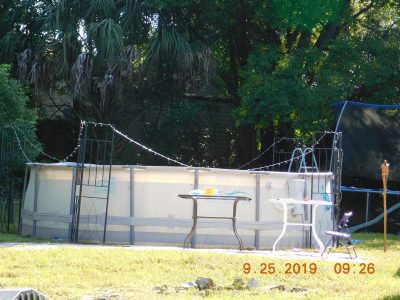
How many violations do you see?
September 25th, 2019
1 comment
Categories: Uncategorized
I enjoy posting photographs submitted by code inspectors. This one is from Kelly Anbach of South Carolina. What would you do as an inspector if a neighbor complained?

A firefighter tragically died in Chicago recently when responding to a call. Unbeknownst to him, the elevator shaft was open where the elevator was being removed, allegedly with no permit. Because of the smoke, he had no way of knowing about this hazard and was killed in the fall. I have been preaching for years about the danger of working without a permit. People cut corners and don’t get the proper permits usually due to the cost or because they don’t want government scrutiny. People die because of this and first responders are often the victims.
I recently had my own experience regarding permits when we needed a new furnace. After speaking with the salesman, I asked whether a permit was needed in my village. He basically said that he wasn’t sure and if we “wanted” to get a permit, we could inquire but many people don’t want “strangers” in their homes and don’t bother. I checked with the building official I used to work with and it turned out I needed one. (In Illinois, not all towns require one). As I told this story to a number of inspectors, they told me that by getting the permit, it pretty well assures me that the installers would not cut corners because they know they will get caught. My opinion is that the salesman was trying to discourage me from getting a permit. I told him so and also that I wouldn’t pay the remainder of the cost until the installation passed inspection.
When a permit is required, it is often because someone died or was injured sometime in the past because of the nature of the hazard. The general public doesn’t understand this and thinks it’s a money making scheme. That has not been my experience. The inspectors it has been my privilege to work with care about safety. Unfortunately, it takes a tragedy like this to educate the public.

Oh, Christmas tree, oh, Christmas tree
Given the technology that is all around us, an inspector needs to act as if everything he or she does is being videotaped. Unfortunately one inspector in Largo, Florida didn’t follow this rule and ended up getting caught by an owner’s surveillance camera. It shows the inspector walking right past a ladder. His boss said he was “counseled” regarding this way of inspecting but no other steps were taken to discipline him according to a report by NBC Channel 8 in Tampa Bay.
When the chief building inspector went to the property, he found numerous deficiencies with the roof. The public responded by arguing that cities just want the permit revenue but don’t want to spend time doing quality inspections. This is very bad publicity because we justify what we do by asserting public safety. You can watch the video by following the link.
Morristown N.Y. recently settled a case with the Amish community over failure to follow the local building code. The Amish had contended they did not need to adhere to the code because of First Amendment freedom of religion considerations. However, they ultimately worked out an agreement whereby criminal charges were dropped. The town recognized that certain building techniques met the code and the Amish agreed not to use other ones that were not deemed proper. Inspectors would install smoke detectors but there would be no enforcement subsequent to the installation. Amish communities are actually growing in the United States. The Washington Times reported that other disputes have arisen in the past with Amish communities over codes but usually it involves waste disposal and outhouses. This is the first time I have heard of the First Amendment being a defense to a building code. I’d be interested to hear if any readers have experience with this issue.
I was recently contacted by a student doing a study about how code enforcement officers handle interactions with anti-government extremists. I’m fortunate that I haven’t encountered this type of threat very often but I promised her I would reach out to my readers to see if anyone has had to deal with this sort of problem. How have you handled it?
There was a very interesting story on National Public Radio yesterday about the relationship between mold and foreclosures. One realtor interviewed said,
“I have a release form that I use, and if the property has got a lot of mold in it, I don’t even let my own husband go in it without signing this disclosure because I don’t want the liability,” she says. “I had one really interesting [one]. It was the middle of winter. There were icicles coming out of the windows above the garage, no heat, but it was 80 degrees inside of the house because it was self-composting.”
The story said that in some states more than 50% of the foreclosed homes have mold and mildew issues. I’ve seen a few of these usually involving burst pipes during the winter. This story raises the frightening possibility that just by sitting vacant, nature takes over the structure when air conditioning and heating no longer are used.
Having the support of the judiciary is critical in obtaining compliance. I’ve been very fortunate in my career to have judges who really understand how important code enforcement is in maintaining communities. Usually when a judge is new, he or she knows little about code enforcement (it is a very narrow area of the law). I view my role as trying to educate them on the issues and the law as I prosecute my cases. Once they see that the inspectors and I are trying to fairly enforce the code for the good of the neighborhood, they are usually supportive and listen closely to my recommendations. Recently, a judge in Ohio chastized a violator, fining a corporation $129,000 for property maintenance violations in an apartment complex. http://www.middletownjournal.com/news/crime/complex-hit-with-129-000complex-hit-with-129-000-in-fines-1023227.html The judge said
“I’m embarrassed and ashamed these conditions exist in the city of Fairfield … We build housing in Haiti, in Africa, but in my own backyard, we have people living in filth. It’s disgraceful and it makes me sad that the working poor don’t have a better place to live.”
Too often it is the working poor who suffer when landlords don’t keep up their property. Judges play a crucial role in righting this wrong.


This blog site is published by and reflects the personal views of Linda Pieczynski, in her individual capacity. It does not necessarily represent the views of her law firm or her clients, and is not sponsored or endorsed by them. The purpose of this blog site is to assist in dissemination of information about legal issues relating to building code enforcement, but no representation is made about the accuracy of the information. The information contained in this blog site is provided only as general information for education purposes, and blog topics may or may not be updated subsequent to their initial posting.
By using this blog site you understand that this information is not provided in the course of an attorney-client relationship and is not intended to constitute legal advice. This blog site should not be used as a substitute for competent legal advice from a licensed attorney in your state. This blog site is not intended to be advertising for legal services and Linda Pieczynski does not wish to represent anyone desiring representation based upon viewing this blog site in a state where this blog site fails to comply with all laws and ethical rules of that state.